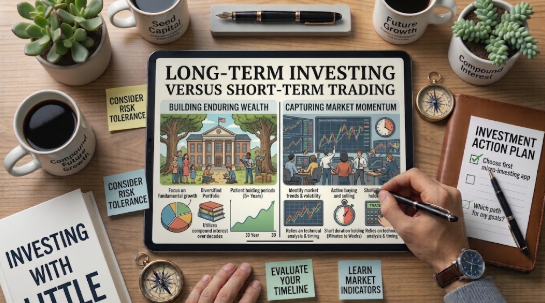
People approach the financial markets with different goals and time frames. Two common approaches are long-term investing and short-term trading. Understanding the distinctions can help clarify which style, if either, aligns with personal circumstances and temperament.
Long-Term Investing
Long-term investors typically buy assets with the intention of holding them for years or decades. The focus is on the underlying value of businesses or broad market growth rather than daily price movements. This approach relies on the historical tendency of diversified stock portfolios to rise over extended periods, while accepting that significant declines can and do occur along the way.
Costs tend to be lower because trading is infrequent. Emotional demands are different: investors must be prepared to endure periods of paper losses without abandoning the plan. Many long-term investors use automatic contributions and periodic rebalancing rather than trying to time market tops and bottoms.
Short-Term Trading
Short-term traders seek to profit from price movements over days, weeks, or months. Strategies may involve technical analysis, news events, or momentum. Success requires frequent monitoring, quick decision-making, and strict risk controls. Transaction costs and taxes on short-term gains can significantly reduce net results.
The emotional intensity is higher. Losses can occur rapidly, and the pressure to act can lead to impulsive decisions. Research on individual traders suggests that a large percentage underperform simple buy-and-hold strategies after costs.
Time, Skill, and Risk
Long-term investing generally requires less day-to-day attention and can be compatible with full-time work or other responsibilities. Short-term trading often demands substantial time, continuous learning, and a high tolerance for volatility. Both approaches involve the risk of loss; neither guarantees profits.
Matching Approach to Goals
Money needed within a few years is usually better kept in more stable vehicles rather than exposed to stock market volatility. Money intended for goals many years away has historically had a better chance of growth when invested in diversified equity portfolios, though past results do not guarantee future performance.
This comparison is educational. Individual results vary widely. Neither long-term investing nor short-term trading is inherently superior for every person. Consider personal goals, time availability, and risk tolerance, and consult a qualified professional when needed.