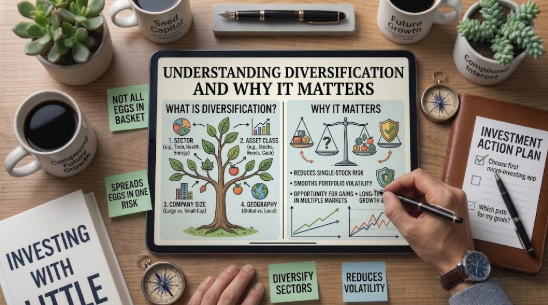
Diversification is the practice of spreading investments across different assets, industries, and geographic regions so that the poor performance of any single investment has a limited effect on the overall portfolio. It is one of the most widely discussed risk-management concepts in investing.
Why Concentration Increases Risk
When a large portion of money is placed in one stock, one sector, or one type of asset, the portfolio’s value becomes highly sensitive to events affecting that single holding. A company-specific problem, an industry downturn, or a regional economic issue can cause significant losses. Spreading investments reduces that vulnerability.
Different Layers of Diversification
Asset allocation refers to the mix of broad categories such as stocks, bonds, and cash. Stocks generally offer higher long-term growth potential along with higher volatility. Bonds typically provide more stability and income, though they also carry risks such as interest-rate changes. Cash and cash equivalents offer liquidity and capital preservation but limited growth.
Within the stock portion of a portfolio, diversification can include companies of different sizes, industries, and countries. Within bonds, it can include varying maturities and credit qualities.
Practical Ways to Diversify
Broad-based index funds and ETFs are commonly used tools. A single fund that tracks a total stock market index or a global stock index can provide exposure to hundreds or thousands of companies. Bond index funds serve a similar role on the fixed-income side. Some investors use target-date funds that automatically adjust the mix of stocks and bonds over time.
Diversification Does Not Eliminate Risk
Even a well-diversified portfolio can decline in value, especially during broad market downturns when many assets fall together. Diversification aims to reduce the impact of idiosyncratic risks rather than remove all possibility of loss.
Rebalancing
Over time, some investments grow faster than others and the original allocation drifts. Periodically selling a portion of the stronger-performing assets and adding to the weaker ones (or adjusting new contributions) brings the portfolio back toward the intended mix. This process is known as rebalancing.
Diversification is a foundational concept, not a guarantee of positive results. This content is educational and should not be interpreted as personalized investment advice. Individual circumstances vary, and professional guidance may be appropriate.